
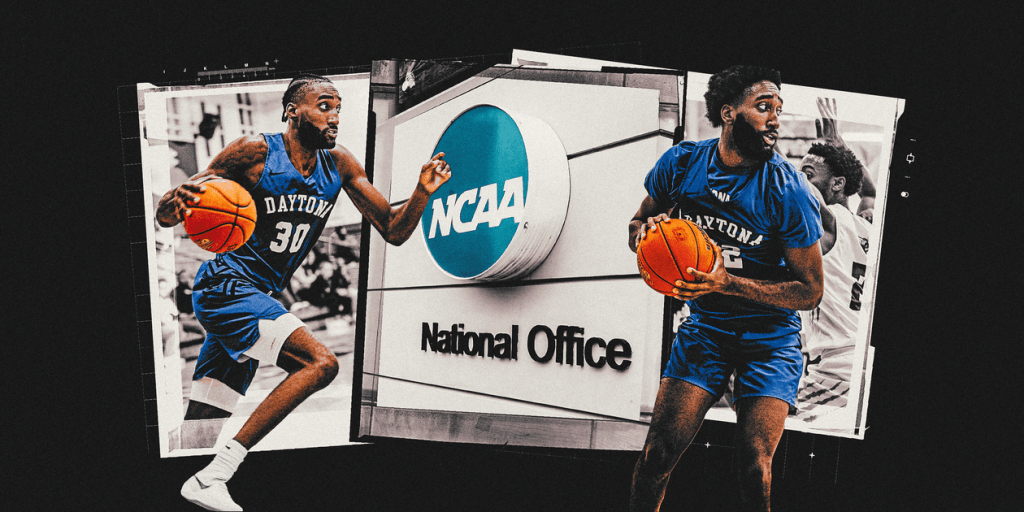

DAYTONA BEACH, Fla. — It’s a scene inside the Lemerand Center on an unfairly cold Wednesday night in early January.
A junior college men’s basketball game is happening in a 1,000-seat gym. Everyone is here for that, including two players who were never supposed to be. But play has been paused. Security is defusing an altercation between the Daytona State College and Santa Fe College women’s hoops teams, who faced off earlier and are now pointing and yelling at each other across the bleachers. One of the Santa Fe players holds back a teammate by yanking on her shirt.
Some of this owes to Daytona State’s baseball squad raising the temperature by sitting behind the visitors bench and trolling them ruthlessly. And now, here come the Santa Fe women, who have been relocated to a section right next to them. The baseball dudes knowingly simmer down. “We don’t want no trouble, guys,” one of them concedes.
But if there’s a trigger to all of it, it’s a tie-up during the first half. A missed shot, some wrestling for the rebound, some choice words and Daytona State’s Ryan Bewley shoving a guy who got in the face of his brother, Matt. That’s when the mercury really jumped. And it brings us to the pertinent question.
What in the world are Matt and Ryan Bewley doing here?
Once upon a time, the 6-foot-9 Bewley twins were the first to hit a new switch on the traditional track for elite basketball talent: Top 15 phenoms who signed with a then-nascent operation called Overtime Elite, exchanging their last two years of high school for training, exposure to scouts and millions of internet eyeballs plus compensation. This was May 2021, one month before a Supreme Court ruling tore down barriers to college athletes profiting off their name, image and likeness (NIL). At the end of two years with Overtime, the Bewleys weren’t ready for the NBA nor eligible to play in the NCAA, fishhooked by the fine print of their choice.
The timing was excruciating.
Why it matters anymore is the issue.
Matt and Ryan Bewley, now 21, started by awing grassroots crowds across Florida. They then went from a throbbing 100,000-square-foot training facility in Atlanta to the far South Side of Chicago and court-ordered basketball purgatory to, on this night, a junior college with 16 women’s golf banners hanging in its gym. They are playing again. There is a joy in that. It helps wash down the thought that NCAA programs blithely use NIL money to make millionaires every year, and it’s completely fine. And they’re the ones paying, still.
“People think me and him just fell off the face of the earth,” Matt Bewley says. “It low-key feels like we’re the only people in the world that are going through what we’re going through.”
If the Bewley boys from Fort Lauderdale were not a figurative tag team, born a minute apart and bonded at every step in their basketball lives, they might have been an actual tag team. They were professional wrestling fans growing up, and that might be underselling it. “Bro,” Matt says, “that’s all we did.” They each can recite their top five all-time grapplers (the Undertaker and “Stone Cold” Steve Austin make both lists), and their enthusiasm occasionally broke the barrier to reality, among other things. Neither is sure who tried to powerbomb whom. They do remember the smashed window, their father asking what happened, and both of them shrugging and saying they didn’t know.
“We got in trouble so many times,” Ryan says. “Broke the bed. Broke the window. Couple of walls have holes in them.”
Given that, and given that they were both 6 feet tall by age 10, it is no shock their mother, Marlene, decided to funnel her kids’ energy into something constructive. They started organized basketball at age 11 in a rec league at the city of Tamarac Community Center. Within a couple years, the Bewleys caught the eye of a local trainer who started working with them daily. By eighth grade, they’d joined Team Breakdown, a prominent Florida grassroots program.
During the summer before their ninth-grade year, they played up against 17U competition at AAU events, leading the world in double-takes induced and creating their own mythology. The Bewleys received power-conference scholarship offers from Iowa State, Florida and South Florida before they attended their first high school class. “They were like grown men playing against little kids,” says Eddie Placer, a guard from Orlando who is now a teammate at Daytona State. “That’s what it looked like out there.”
“We always compared them to the X-Men,” says Gerald Gillion, who has known the Bewleys since they were 13 and who served as Chicago State’s head coach for their one year on campus. “Really powerful mutants that, in the right situation, can do some very, very good things.”
Following two dunk-filled seasons at two different Florida high schools, the road forked. A new venture built by the media company Overtime, one that counted Amazon founder Jeff Bezos and more than 25 NBA players among its initial investors, made its pitch: Complete a high school education while training and playing at an academy in Atlanta, receiving exposure from a brand with a combined social media audience of more than 50 million people. Overtime Elite offered a minimum $100,000 salary plus bonuses and company stock to any player willing to take the leap. The aggressively untraditional terms were no secret. System disruption was the entire point.
Ryan Bewley was on board, primed for something more than Florida high school competition. “Iron sharpens iron,” he says now.
Matt Bewley was not, struggling with the idea of leaving home and friends behind. “I just felt like I was growing up too fast,” he says.
A visit to Overtime Elite’s facilities and reconsidering how reported seven-figure contracts would impact, well, everything in life recalibrated his thinking. The family likewise took into account the uncertainty of post-pandemic basketball in Florida and weighed it against predictable high-end training — “A path to getting to the league,” their father, Prince, says — combined with a centralized education structure and small class sizes. “It encompassed everything we needed,” Marlene says.
2023 Matt Bewley ranked top 25 in the country regardless of class (2021-2024) in ESPN latest rankings pic.twitter.com/rQ1ZB0EB3D
— Team Breakdown (@TeamBreakdown) August 21, 2020
On May 21, 2021, the news release dropped: Five-Star Prospects Matt and Ryan Bewley Make History as First Signings for Overtime Elite. “Signing these two great pillars for our program is an exciting beginning,” Brandon Williams, the organization’s head of basketball operations, said in the statement. Every report about the deal included a note that the Bewleys were forfeiting high school and NCAA eligibility. (In the very next recruiting cycle, Overtime Elite offered prospects a plan for joining while also maintaining an ability to play Division I basketball.)
It can be true that teenagers may not be altogether concerned with details — “I don’t think anybody at that age can understand the repercussions of anything,” Matt says — and also that obliviousness is not an out. “Going into it, the eligibility part of it, maybe at that particular time, I didn’t completely understand,” Marlene says.
Says Prince Bewley: “What sold me was, every day, the training, the facility, the coaches, the environment was to train these guys like an NBA-type thing. But they’re high school players. That’s it.”
Exactly one month later, the Supreme Court upheld a lower court’s ruling in NCAA v. Alston that cleared the way for college athletes to profit off NIL. It might’ve been a footnote in the Bewleys’ story had their chosen route worked out. It didn’t. Overtime Elite fulfilled its promise of development and exposure; 20 of the original 26 players to sign have spent time on professional rosters somewhere worldwide. (And one is a football player at Georgia.) The Bewleys simply did not rise to that level. They scored and rebounded but also averaged less than an assist per game and didn’t make a single 3-pointer between them in the 2022-23 campaign. They were not pro prospects. Not yet. They were, in fact, provided the option to spend a third year with Overtime Elite. Instead, they decided to make a run at Division I college basketball, against the headwinds of their choices, insisting that they do not regret them.
“Obviously, there are situations you go through in life where you’re like, damn, I should have made a different decision,” Matt Bewley says. “But nah, I feel like it’s just part of the story. That’s all it is. Wherever else we go, wherever this takes us, it’s just part of the story.”
They turned the corner and ran over traffic spikes. The Bewleys signed with Chicago State, a Division I program with a sympathetic coach in Gillion and zero winning seasons since 1986. They were heralded as “once-in-a-generation-type talents” who would have an “immediate impact.” The Bewleys applied for amateur certification in June 2023 and, later that month, the NCAA informed the school they were unlikely to get it. On Oct. 31 — one week before the first regular-season game — the NCAA made it official: non-certified. In short, the NCAA ruled the Bewleys had made too much money, beyond its acceptable limits for amateurs.
The Bewleys filed a federal antitrust lawsuit the next day, seeking a temporary restraining order and injunction against the NCAA. A judge in the U.S. District Court of Chicago denied them on Nov. 14. After a December hearing, the judge then denied the Bewleys’ request for reconsideration and a preliminary injunction on Jan. 14, 2024, concluding that they “have not established a likelihood of success on their claims that (the NCAA’s) bylaws are unreasonably anticompetitive or restrictive.”
The door wasn’t dead-bolted shut. It was removed and replaced with a concrete wall. The Bewleys were seemingly the only people to sue the NCAA and lose.
“You know how you have that passion for something?” Ryan Bewley says now. “And that love for something? And it just gets taken away from you? … And you keep trying and trying and trying, and people are in your ear saying, it’s going to get better, it’s going to get better — and it doesn’t get better. It’s like, aw, man, your hopes are too high.”
They now couldn’t play competitive basketball while marooned on a campus a good 30-minute drive away from anything interesting. “Some days, I cried,” Ryan says. The judge’s initial ruling bruised them so badly, they declined to accompany Chicago State to the Cancun Challenge in November; by 2024, they couldn’t travel with the team even if they wanted to. “Me and him were legit depressed,” Matt Bewley says. When they did join everyone in the gym, the Bewleys served as high-end scout-teamers. “Practice dummies,” as Ryan puts it, and they admit their personal investment levels dropped accordingly.
“It was so bad I used to be scared to even go to the park and play a pickup game,” Matt says. “Because I’m just like, yo, I haven’t done anything.”
At the end of the school year, the Bewleys returned to Florida and entered the NCAA’s transfer portal. Maybe they could join Gillion at Long Island University, where he’d taken an associate head coach spot. High-major coaches called, Marlene says, trying to sort out the twins’ status. But weeks went by. Nothing changed, and no one wanted to risk another year of idle exile. Matt considered quitting basketball. He figured he’d find something, he says now, that tall people could do.
It was mid-summer when Joey Cantens, the head coach at Daytona State College, logged into a database that ranks the available players in the portal. He noticed two familiar names near the top of the list.
On a whim, Cantens called Gillion, whom he’d known for almost two decades.
“Hey,” Cantens asked, “what are the twins doing?”
A few weeks after competing in a U20 European championship tournament in July as Great Britain’s point guard, and a few days after settling in for a year of junior college basketball in the United States, Tyrese Lacey arrived at the doors of the Lemerand Center to let his coach in the building. The sight of two extremely large humans flanking Cantens staggered him. On the elevator ride to the second floor, Lacey confirmed that, yes, in fact, these extremely large humans were related.
The elevator doors opened. The tour continued. You know they’re the Bewley twins, the Birmingham, England, native was told, expectantly.
“I’m like, ‘Who the hell are the Bewley twins?’” Lacey says now.
That was the question, wasn’t it?
In August 2024, two former five-star prospects were at the doorstep of an 11,000-student commuter school with a $3,100 tuition for Florida residents. Three years removed from famously upending an ecosystem. A year and a half removed from competitive basketball. Walking existential crises. When the Bewleys first entered the transfer portal in the spring of ’24, junior colleges across the country reached out to gauge their interest. The brothers didn’t reply. “I’m like, obviously me and him are never going to juco,” Matt says.
But eligibility in this realm works differently. The Bewleys could play. Immediately. Unless they intended to spend another season in suspended animation, they were out of alternatives.
“This is literally the purpose of community college,” Cantens says, “is to serve kids like them.”
Daytona State offered a soft landing to boot. Cantens was an energetic 38-year-old with experience as a Division I staffer at both Florida Gulf Coast and USC, whose Daytona State teams had won 55 of 63 games the previous two years while deploying a high-tempo, 3-pointer-heavy modern offense. Most critically? The Miami native played for the same AAU program as the Bewleys. He knew the people they knew. “That’s just family,” is how Matt puts it. As for the infrastructure, the twins could do far worse. A $16 million residence hall, opened in 2022 and steps away from the gym entrance, housed athletes. The cafeteria, not much farther away, served three meals a day. There was a stash of nutritional snacks available every day and an athletic trainer who whipped up post-workout smoothies. No strength coach or video coordinator. No zero-gravity treadmills or charter flights. But hardly a basketball skid row.
In a lower corner of the whiteboard in Cantens’ office, there’s a program mantra scribbled in black ink: This is a transient program for future pros. Not a dead end program for losers. “We start practice and if you’re not here an hour and a half early, doing your lift routine, your stretch routine, your shooting routine, if you’re not getting protein after practice — I have a problem with you,” Cantens says. “Because you’re not setting yourself up for success.”
The Bewleys signed on. How it would go was a cliffhanger for everyone.
Weary after the previous three years and wary of more disappointment, the twins kept to themselves in the early days. “You could tell there was still a dark spot there,” Lacey says. They’d sat on the couch in Cantens’ office and insisted that all they wanted was to be part of a team and chase a championship. Cantens didn’t totally buy it, suspicious the Bewleys were parroting some well-rehearsed lines from Overtime Elite media training. Someone like Isaiah Dorceus, a guard who didn’t have gaudy rankings and who isn’t 6-9 and who had one year left to prove worthy of a Division I roster spot, simply didn’t want anyone to wreck the good vibes.
Pickup games riddled with trash talk chipped away at the twins’ shells. So did team trips to the beach. Two players who admittedly don’t get up early for much of anything submitted to 5 a.m. workouts. They also forged ahead when it became clear their conditioning levels were not 5 a.m. workout-ready. (“I think the first workout, I made Matt throw up,” Cantens says.) It wasn’t long before the Bewleys were just two more players at Daytona State with bendy-straw career paths.
“They live in the dorms like everybody else, they eat in the cafeteria like everybody else, they get yelled at by me like everybody else,” Cantens says. “And they do a good job of cheering their teammates. And when you see that, you realize, OK, this is real. They really just want to be part of something that they missed.”
As Ryan Bewley puts it, simply: “I’m having that joy again, you know?”
To be clear: They absolutely want something more. They believe they are future NBA players.
But functional jump shots and defensive awareness, not pro roster spots, are the next rungs on the ladder. Seeing the Bewleys play is seeing the possibilities everyone sees. Matt’s end-to-end speed and chin-at-the-iron vertical on lobs. Ryan’s raw feel that, if honed properly, could make him an enviable offensive facilitator at his size. It is the stuff that draws coaches from Illinois, LSU, Penn State, St. Bonaventure, James Madison, Vermont and more to this outpost on the Florida coast, just in case.
It’s also seeing the hitch at the top of Matt’s jumper and realizing he hasn’t