


This article is supported by SIDA
[DAR ES SALAAM, SciDev.Net] The lush banana plantations of Morogoro district in central Tanzania have always flourished, a vibrant green that symbolized not just agricultural success but also local food security. However, a disturbing sight caught the eye of science journalist Ashton Balaigwa just three weeks ago: the bright leaves began to wilt, transitioning from green to a concerning shade of brown.
To someone unfamiliar with agricultural ailments, this deterioration could seem like a standard occurrence due to dry-season stress or a lack of water. Yet, for Balaigwa, who had participated in specialized training for journalists focusing on agriculture, these symptoms rang alarm bells. With knowledge gained just a year prior, he understood that the stakes were high.
Driven by a sense of urgency, Balaigwa took photographs of the afflicted plants and shared them in a WhatsApp group established to facilitate communication between science journalists and agricultural researchers. His proactive approach quickly garnered responses that suggested a possible outbreak of Banana Bunchy Top Virus (BBTV), a disease notorious for stunting banana plants and severely reducing their fruit yield.
BBTV is primarily transmitted by banana aphids (Pentalonia nigronervosa) and via infected planting materials. The implications of such an outbreak are dire; within merely two seasons, infected plants can witness a devastating 90 to 100 percent reduction in fruit production. First identified in Tanzania from late 2020 to early 2021, this virus poses a significant threat to food security across Sub-Saharan Africa, where bananas serve as both a staple food and a vital cash crop.
Recognizing infected plants early is critical for farmers, as the disease can spread rapidly to adjacent healthy plants. Balaigwa emphasized the importance of timely actions such as removing affected plants and using disease-free planting material to mitigate the spread. He took this message back to Kauzeni village, where he communicated with the farmers about the potential infection.
“You need to act fast before it spreads further,” he urged, sharing insights from scientists on how to safeguard neighboring banana crops through proper sanitation and management strategies.
Disease Detectors
For Deogratius Protas, the principal research coordination officer at the Tanzania Commission for Science and Technology (COSTECH), this incident highlights the immense value of training journalists to recognize and report on agricultural diseases. Protas was involved in training 27 journalists, including Balaigwa, to improve science reporting for community development, particularly in light of the 2021 BBTV outbreak.
According to Protas, Balaigwa’s quick intervention was pivotal in curbing the disease’s spread. “Without the engagement of journalists,” he noted, “the disease would have remained largely unknown in these communities, leading to severe economic and food security consequences for smallholder farmers.”
Empowerment through education allows journalists to spot symptoms and verify them in real-time with scientists, thereby raising public awareness and inspiring timely community action against agricultural threats.
Banana Replanting
However, for farmers already grappling with BBTV, simply being aware of the problem does not resolve the crisis. Kosa Kondo, a farmer from Mzinga ward in Morogoro district, spoke candidly about the impact of the disease on his livelihood. “In better times, I would reap 30 to 40 banana trees every three months. Now, I can barely manage enough for my family, let alone for commercial purposes,” Kondo shared with SciDev.Net.
As the disease swept through his fields, he faced additional challenges, specifically the quest for disease-free planting material to replace the infected crops. In a bold move to adapt, he decided to pause banana cultivation altogether, opting instead to grow beans.
“After consulting with experts, I’ve put bananas on hold. I’m planting beans and waiting for better days—when I can restart my banana cultivation with healthy seeds in uncontaminated soil,” he explained. Kondo added that obtaining healthy seedlings for new banana plants is often a daunting task. “We need to raise more awareness about this issue beyond what experts currently tell us,” he suggested.
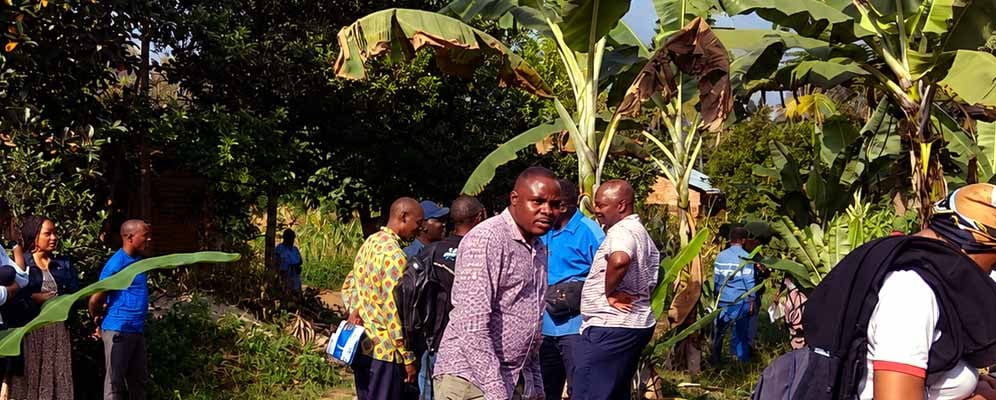
A team of journalists and researchers in Tanzania during a field visit to farms affected by Banana Bunchy Top Virus (BBTV) in Morogoro Region, Central Tanzania. Photo courtesy of Tanzania Commission for Science and Technology (COSTECH).
Science in the Field
Hosea Mtui, a researcher and lecturer in the Department of Crop Science and Horticulture at Sokoine University of Agriculture, emphasized the crucial link between scientific research and media-driven awareness in empowering smallholder farmers to combat BBTV. “Integrating scientific research with practical media awareness gives farmers a better fighting chance against the disease,” Mtui noted.
He explained that utilizing integrated management strategies based on scientific knowledge could significantly reduce disease spread while lowering production costs. Such approaches not only enhance banana yield and quality but also help protect treasured local banana cultivars, thereby ensuring both household income and national food security. This combined effort underscores the importance of connectivity between scientists and the agricultural community in the face of looming agricultural threats.
This piece was produced by SciDev.Net’s Sub-Saharan Africa English desk.