


Exploring the Intersection of Biology and Technology with BIOPIX
In the fascinating realm of vision, both biological systems and digital technologies share a fundamental mechanism: the conversion of light into electrical signals. According to a research team from Italy, led by Professor Thomas M. Brown from the University of Rome Tor Vergata, biological vision relies on components such as the retina, while digital vision depends on image sensors commonly found in cameras. Both systems process important visual attributes like color, brightness, and contrast but differ significantly in their environments. The former thrives in wet biological settings, while the latter is typically composed of solid-state components.
The Groundbreaking BIOPIX Development
Enter BIOPIX—the innovative proof-of-concept developed by Professor Brown’s team that elegantly combines the wet environment of biological vision with solid-state electronic technology. This bioinspired pixel sensor array features sensors fabricated from organic electronics and embedded in a biological liquid medium. What makes BIOPIX particularly unique is its ability to replicate the dichromatic, cone-mediated vision commonly seen in mice, as well as incorporating rod-like polymer sensors for grayscale representation.
The design includes a 2×2 array for color perception and a more comprehensive 4×4 array, which facilitates grayscale vision. The arrays are fabricated using a stencil printing technique on microelectrodes and encapsulated in Ames’ medium, a specially formulated water-based liquid that serves as an electrolyte, making it suitable for retinal research.
Mimicking Biological Mechanisms
As Professor Brown and his team point out, the BIOPIX device fundamentally captures light in a manner that closely emulates the intricate mechanisms of biological vision. Post-doctoral researcher Ebin Joseph elaborates on this by stating that the device not only senses color effectively but also does so with a speed that mimics the natural retina, responding in tens of milliseconds. This response time reflects the ionic dynamics found in mammalian retinas. Furthermore, the sensitivity of BIOPIX is on par with established solid-state polymer semiconductor photodetectors, merging the best of both worlds.
Real-Time Color Image Generation
One of the most exciting developments with BIOPIX is its capacity to generate real-time color images. The research team successfully connected the device to a screen, demonstrating a groundbreaking direct-to-display image generation process. Dr. Luca Di Nunzio, a digital electronics and signal processing expert on the team, described the challenges encountered during this process, particularly in developing an electronic readout system that accommodates BIOPIX’s unique ionic liquid retina-like timing.
The ability to produce pixelated images in real-time provides a functional demonstration of how this innovative technology can be employed in future applications, ranging from research to medicinal uses.
Testing for Biocompatibility
Another crucial aspect of the BIOPIX project was ensuring the device’s biocompatibility. Co-leader of the study, Professor Antonella Camaioni, noted that in vitro tests with human mesenchymal stromal cells confirmed the platform’s viability for further investigation. The implications of successful biocompatibility extend into future medical applications; an artificial retina like BIOPIX could potentially restore sight lost to diseases or age-related conditions such as macular degeneration.
Future Applications and Research Directions
Looking ahead, Professor Brown envisions a wide array of applications for the BIOPIX retina emulator platform. It holds promise for studying new photoabsorbing artificial photoreceptor materials and assessing their performance in various environmental conditions. This platform can provide valuable insights into how image sensing operates at the interface of biological (liquid) and solid-state (semiconducting) materials.
As we stand at the crossroads of biology and technology, advancements like BIOPIX illustrate the potential for hybrid systems to enable groundbreaking developments in vision technology. The research not only inspires new possibilities in the realm of artificial retinas but also ushers in a new understanding of the intricate relationship between the two domains.
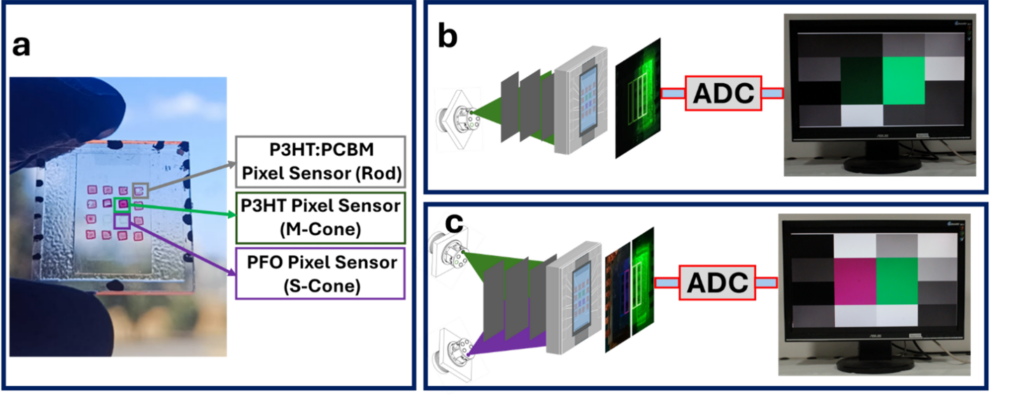
Image: The BIOPIX device, showcasing its novel pixel architecture designed to mimic biological vision, along with experimental setups for color and grayscale imaging.
A New Era of Bio-Electronics
The work being done in the arena of bioelectronics continues to blur the lines between artificial and natural systems, creating solutions that could one day redefine our approach to vision and beyond. As researchers delve deeper into the complexities of integrating organic electronics within biological contexts, the horizon looks promising, revealing endless opportunities for innovation that harmonizes technology with the biological world.