


The Cosmic Wonder of LHA 120-N44: A Superbubble in the Universe
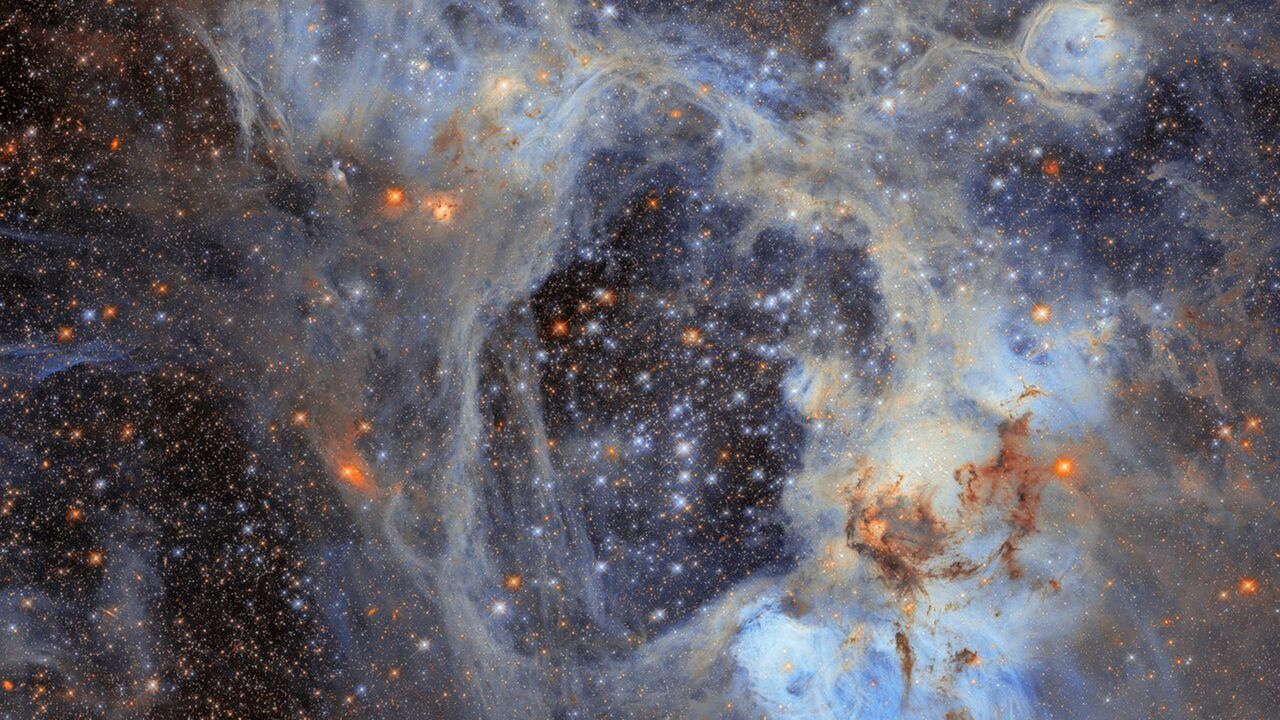
Quick Facts
What it is: The nebula LHA 120-N44
Where it is: 160,000 light-years away, in the constellation Dorado
When it was shared: Sept. 3, 2026
When we gaze into the night sky, we often wonder about the magnificent phenomena that lie beyond our reach. One such marvel is the nebula known as LHA 120-N44, or simply N44, a stunning display of cosmic dynamics 160,000 light-years from Earth, nestled in the Large Magellanic Cloud, a satellite galaxy to our Milky Way.
The Marvelous Structure of N44
At first glance, the N44 nebula resembles a colossal void, as if a giant hole had been punctured in a cloud. However, this ghostly appearance belies a complex narrative of stellar birth and death. Measuring approximately 210 by 140 light-years, this vast region is what astronomers call a “superbubble.” This term describes a cavity formed by a cluster of massive, hot stars that illuminate their surroundings while simultaneously tearing apart the very material from which they arose.
The Genesis of Stellar Destruction
The central stars of N44 are not only spectacular; they are also agents of destruction. Similar to how our sun emits solar winds, the massive stars in this cluster generate powerful stellar winds that blow gas and dust into space at incredible velocities. The lifecycle of these stars is turbulent: the most massive will inevitably detonate as supernovae, generating shockwaves that further disperse and compress surrounding materials, thus amplifying the nebula’s hollow appearance.
This cycle of destruction offers a fascinating perspective on the lifecycle of a star. Not only do these stellar giants carve out their environment, but they also play a crucial role in shaping future generations of stars.
Stellar Feedback: A Dual Role
What happens to the gas expelled from these supernovae? Much of it is blown outward, forming a dense shell of superheated gas and dust encasing the superbubble. Within this shell, conditions become ripe for new stars to form. This phenomenon is known as “stellar feedback.”
Essentially, while massive stars radiate heat and energy, preventing star formation in their immediate vicinity, they simultaneously compress neighboring gas clouds until they collapse under their own gravity, eventually birthing new stars. Thus, the same forces that destroy an old generation of stars help to spawn the next.
A Crucial Research Opportunity
The Hubble Space Telescope’s observations of N44 reveal a tapestry woven from nearly half a million stars, a portion of which lie along our line of sight. Among these celestial bodies, approximately 30,000 are young stars that are still in the formative stages, yet to ignite hydrogen in their cores. This remarkable concentration provides astronomers with a unique opportunity to explore a question fundamental to our understanding of stellar evolution: how long does it really take to form a star?
The nebula offers an excellent natural laboratory for this inquiry, allowing researchers to study star formation in real-time in a relatively confined space. By observing the various stages of stellar development within N44, scientists can begin to piece together the intricate timeline of star birth, a puzzle that has long intrigued them.
The Cosmic Dance Continues
As we delve into the mysteries of LHA 120-N44, we recognize that this nebula is not merely an astronomical object but a testament to the ceaseless dance of creation and destruction that characterizes our universe. Each star that forms contributes to a cosmic symphony that has been playing for billions of years, echoing through the vastness of space and time.
Through the lens of the Hubble Space Telescope, we are granted a breathtaking glimpse into this dynamic landscape, urging us to ponder not just the complexity of nebulae like N44, but our place in the grand tapestry of the cosmos. The universe, vast and ever-changing, invites us to keep learning, observing, and pushing the boundaries of what we know.